01
Player feedback & health
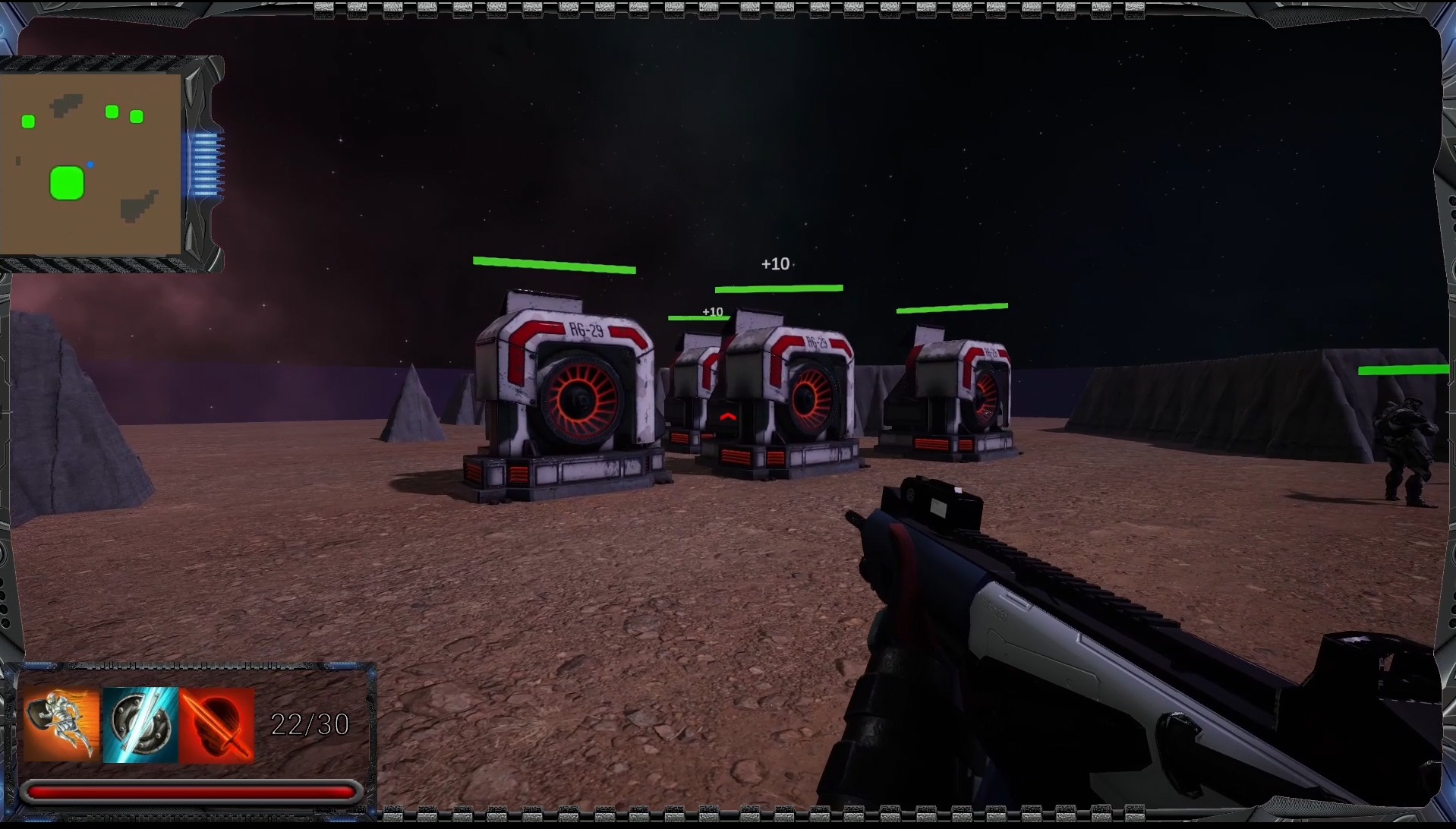
Implemented the player health bar and its behaviour, created the supporting visual assets, and extended the shared event system with maximum-health and healing-related state.
Licensed diploma project
A licensed Unity diploma project combining first-person combat, real-time strategy and procedurally generated objectives in a science-fiction battlefield.
Licensing & ownership
The source code is not publicly available because the project is licensed and jointly owned. This project page uses the dissertation and development history to distinguish my documented work from shared implementation and the wider team result.
Project overview
Haardon asks the player to think like a commander and fight like a soldier. Strategic decisions shape the battlefield, while first-person action makes the consequences immediate.
The team designed a loop around building and combat phases. From the RTS view, the player expands defensive locations, manages resources, constructs buildings and commands allied units. In FPS mode, the player enters the battle directly with weapons and abilities. Procedural terrain and randomly generated objectives were used to make each scenario less predictable.
My original idea was to combine the speed and presence of an FPS with the planning of an RTS. I brought participants from two student groups together, led the first brainstorming sessions and helped turn that concept into a shared diploma project with a playable Unity build and a formal technical dissertation.
Gameplay trailer
The trailer demonstrates first-person combat, strategic structures, abilities, enemy encounters and the project’s science-fiction presentation.
Trailer hosted on Vimeo. I contributed the trailer music as part of the project’s final presentation.
My contribution
My work crossed gameplay programming, player presentation, prototypes, technical writing and project direction. Shared items are described as contributions rather than sole ownership.
01
Implemented the player health bar and its behaviour, created the supporting visual assets, and extended the shared event system with maximum-health and healing-related state.
02
Integrated the player model and animation assets, worked with the FPS weapon camera, and contributed to player movement and camera-control code as part of the shared character system.
03
Co-developed the Healing Aura ability and its connection to GameEventSystem, helping translate a team-designed ability into health changes and visible player feedback.
04
Built an early modular save-system prototype for player position and a work-in-progress high-score system. These experiments informed the architecture even though the high-score feature was not part of the final build.
05
Originated the core hybrid concept, brought students from two groups into one project team, led the initial brainstorming and helped keep the gameplay, technical work and dissertation aligned.
06
Contributed to the English abstract, game design, Unity methods, player-model and FPS-camera sections, discussion, future work, conclusions and references, and created music for the game trailer.
Evidence note: the surviving Git history includes health-bar and healing-event work, the early binary save prototype, high-score experiments, player-model and animation integration, and shared player/camera changes. Because the repository contains merges and collaborative systems, this page prioritises specific capabilities over commit volume.
Agile delivery
We managed the diploma as an iterative team project, progressing through early alpha, beta and final-product milestones rather than waiting for one large submission.
Jira gave the team a shared view of scope, ownership and progress.
We met twice each week to review completed work, discuss blockers, split upcoming tasks and adjust priorities. As project lead, I helped translate the agreed direction into actionable Jira tasks and kept technical implementation, documentation and milestone expectations visible to the whole team.
Tools & practices
Jira · shared backlog · task assignment · milestone planning · twice-weekly reviews · iterative delivery
Established the playable foundations, validated the FPS/RTS concept and gave the team a concrete build against which responsibilities and technical risks could be reviewed.
Brought the main gameplay systems into a more complete loop, integrated work from across the team and used regular review meetings to identify blockers, defects and remaining scope.
Focused on integration, stability, presentation and diploma delivery, completing the playable build alongside the dissertation and game trailer.
Team outcome
The broader implementation was divided across the team and integrated into one game loop. These systems describe the delivered project as a whole, not my sole authorship.
Technical approach
Combining two genres meant coordinating character control, strategy commands, generated environments, interface state and enemy behaviour inside one Unity runtime.
01
Unity · C#
02
FPS combat · RTS commands · abilities
03
Procedural terrain · generated objectives
04
Animator · Animation Rigging · IK
05
Game events · coroutines · modular systems
06
Unity Job System · pathfinding
Performance challenge
The dissertation records a team optimisation that moved pathfinding work away from the main thread with Unity’s Job System, reducing the measured calculation from roughly 50 ms to about 0.2 ms in the documented test.
Scope discipline
The early save and high-score work helped explore persistent state, but the high-score system remained unimplemented in the final experience. Keeping that distinction visible is part of presenting development work responsibly.
What I learned
Primary project document
The full team dissertation documents the game design, implementation, challenges and conclusions behind the playable build.
Haardon diploma dissertation
Scroll inside the preview to read, resize it vertically from the lower edge, or use the full-reader link for the browser’s complete PDF controls.
Project status
Haardon progressed from early alpha through beta to a playable, documented final diploma release in 2024.
The project demonstrates my early game-development experience in Unity and C#, but also the broader responsibility I took for forming a team around an original concept, planning work in Jira, contributing to shared technical systems and helping communicate the final result. It remains a collaborative work: the finished game reflects the combined engineering, design, writing and presentation effort of all five team members.
Watch the result